10 Content Distribution Strategies to Maximise Webinar ROI and Save Time
Discover 10 actionable content distribution strategies to save time and prove ROI. Turn your webinars into 30+ days of content effortlessly. Learn more!

Your company invests thousands of US Dollars into producing a single webinar. From speaker fees and platform costs to weeks of promotional effort, the upfront cost is significant. Yet, for most B2B marketing teams, that high-value asset gathers digital dust the moment the live event ends. Its potential for long-term ROI is immense, but it remains locked inside a 60-minute recording.
The manual process of repurposing is a recognised bottleneck. Manually chopping up a long recording into social posts, blog articles, and video clips is a time-consuming, expensive nightmare. It often requires multiple disjointed tools, specialised production skills, or outsourcing to an agency—all of which drain your budget and delay your go-to-market speed. This inefficiency means your most valuable content is chronically underutilised.
This article provides a practical blueprint to change that. We'll outline 10 powerful, time-saving content distribution strategies designed specifically for B2B marketers who need to maximise their webinar investment. You will learn how to systematically turn one 60-minute webinar into 30 days of high-performing content that drives leads and engagement. Forget hiring a production team or wrestling with complex software. These are actionable, efficient workflows for turning your webinar archive into a perpetual content engine that demonstrates clear ROI.
1. Strategy 1: Multi-Channel Repurposing
Multi-channel repurposing is one of the most effective content distribution strategies for maximising the return on investment (ROI) of your high-value assets. This approach involves taking a single, comprehensive webinar and strategically breaking it down into numerous smaller, platform-specific assets. Instead of letting a valuable one-hour webinar gather digital dust, you transform it into a library of content designed for different channels and audience engagement styles.
The core principle is simple: one webinar is not one piece of content; it's dozens. From a single 60-minute recording, you can generate 6-16 image quotes, multiple short-form video clips for social media, a detailed blog post for SEO, and an engaging email sequence. This method allows you to turn one hour of effort into 30 days of content, saving an enormous amount of time.
Why this strategy is essential for B2B teams
Webinars are expensive to produce. Leaving that asset underutilised is a significant waste of resources. Multi-channel repurposing directly addresses this pain point by extending the lifespan and reach of your investment, ensuring your message continuously engages prospects across their entire customer journey without manual work.
- Boosts ROI: Turn a single webinar, which can cost thousands of US dollars to produce, into 30+ days of marketing content.
- Increases Reach: Adapt your core message for different platform algorithms and user behaviours, from professional discussions on LinkedIn to quick tips on Instagram Reels.
- Saves Time: Instead of brainstorming new content from scratch, you pull from a proven, high-value asset, eliminating the need for multiple tools or hiring freelancers.
For B2B companies like HubSpot and Salesforce, this isn't just a tactic; it's a foundational part of their content engine. They systematically convert keynotes and webinars into everything from blog posts to social media carousels.
Key Insight: The goal isn't just to chop up a video. It's to strategically re-package insights into formats native to each platform, ensuring maximum relevance and engagement—without the manual labour.
Manually executing this can be a drain on resources, often requiring multiple tools, freelancers, or significant in-house time. To learn how to automate this entire workflow and get professional results in minutes, explore platforms that specialise in webinar content creation. Find out more about streamlining your webinar repurposing on repurposemywebinar.com.
2. Owned Media Optimization (Website & Blog)
Owned media optimisation is a foundational pillar among content distribution strategies, focusing on publishing high-quality, SEO-optimised content directly onto your own digital properties like your website and blog. Instead of renting space on third-party platforms, this approach centres on building a long-term, high-value asset library that you completely control. It transforms your website from a simple brochure into a powerful, organic traffic-generating machine.
The core principle is to turn ephemeral webinar content into permanent, searchable assets. A one-hour webinar transcript can be expertly crafted into a comprehensive blog post that attracts highly qualified leads for months or even years. This strategy was championed by SEO pioneers like Brian Dean of Backlinko, who demonstrated how in-depth, resource-driven content could dominate search engine results pages (SERPs). By hosting this content on your domain, you build authority, capture first-party data, and control the user experience from start to finish.
Why this strategy is essential for B2B teams
Relying solely on social media or third-party sites for distribution means you're building on rented land. Owned media optimisation ensures your most valuable insights contribute directly to your domain's authority and lead generation engine. It’s the most reliable way to create a sustainable inbound marketing funnel from your webinar programme.
- Builds Lasting SEO Value: A single webinar-derived blog post can rank for valuable keywords, driving consistent, free organic traffic long after the live event.
- Establishes Authority: Housing comprehensive, expert-led content on your site positions your brand as a go-to resource in your industry.
- Full Control Over Conversion: On your own site, you dictate the call-to-action (CTA), the user journey, and the data you collect, unlike on social platforms.
B2B giants like HubSpot leverage this by turning webinars into thousands of blog articles that attract millions of monthly visitors. Similarly, Moz transforms research-based webinar findings into top-ranking posts for high-intent keywords, proving the strategy's effectiveness.
Key Insight: The goal is to convert the spoken expertise from a webinar into a written format that search engines can crawl, index, and rank, creating a perpetual lead-generation asset.
Converting a webinar transcript into a well-structured, 2,000-word article requires strategic planning and optimisation. To dive deeper into crafting these high-performance assets, explore our guides on the topic. Find out more by reading our blog on webinar content strategy.
3. LinkedIn Native Distribution
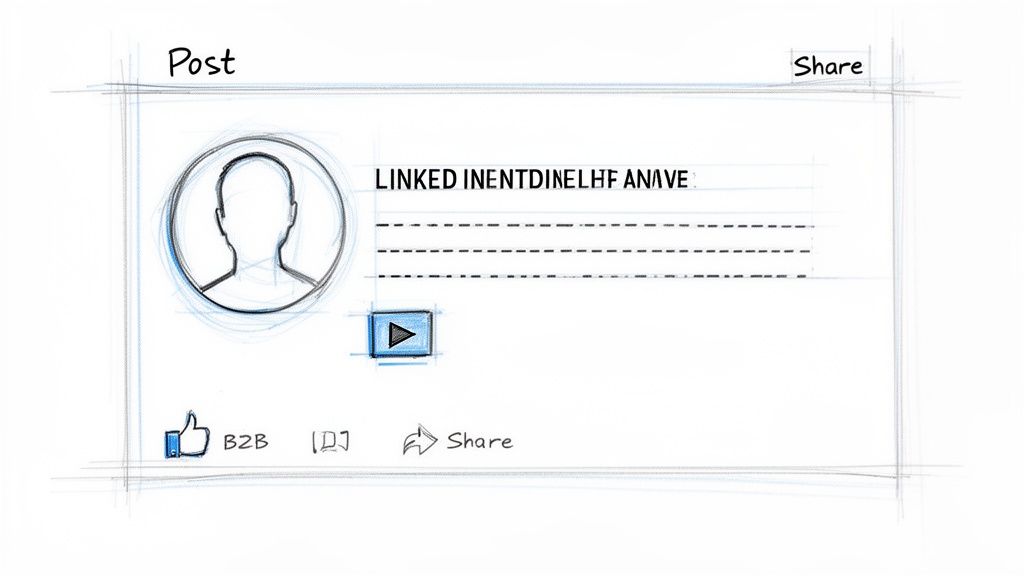
LinkedIn Native Distribution is a powerful content distribution strategy focused on publishing content directly to the platform instead of linking out to external websites. This approach capitalises on LinkedIn’s algorithm, which rewards content that keeps users engaged within its ecosystem. Rather than just sharing a link to your webinar recording or blog post, you upload videos, documents, and text posts natively, significantly boosting visibility among B2B decision-makers.
This method is about meeting your audience where they are most active professionally. By creating content formats tailored for LinkedIn, like video clips, carousels, and articles, you transform a single webinar into a stream of engaging, platform-specific assets. Tech companies like Loom and Calendly have perfected this, turning webinar clips and insights into posts that consistently generate tens of thousands of impressions and drive meaningful conversations.
Why this strategy is essential for B2B teams
LinkedIn is the definitive B2B social network, yet many teams fail to maximise its potential by posting external links that the algorithm deprioritises. Native distribution solves this by directly increasing your organic reach and establishing your brand as a credible authority within your industry, right in the newsfeeds of your target customers.
- Increases Organic Reach: Native content like carousels and videos often receives 5x higher engagement than posts with external links, pushing your content to a wider audience.
- Builds Thought Leadership: Repurposing webinar transcripts into detailed LinkedIn Articles positions your key speakers and brand as go-to experts in your field.
- Drives Qualified Engagement: Native content encourages comments and discussions directly on the platform, allowing you to interact with prospects and build relationships.
For companies like Monday.com, turning webinar takeaways into 8-10 slide carousels is a standard play that yields over 100,000 impressions per post. This proves that delivering value directly within the feed is the key to winning on LinkedIn.
Key Insight: Stop trying to pull your audience off LinkedIn. Instead, deliver your most valuable insights natively on the platform to capture their attention and build trust where they are already active.
Manually creating dozens of native LinkedIn assets from a single webinar is a huge time commitment, involving video editing, graphic design, and copywriting. To learn how to automate the creation of LinkedIn carousels, video clips, and text posts from your webinar recordings, explore platforms designed to streamline this entire workflow. Find out more about automating your webinar-to-LinkedIn content engine on repurposemywebinar.com.
4. Short-Form Video Distribution (TikTok, Instagram Reels, YouTube Shorts)
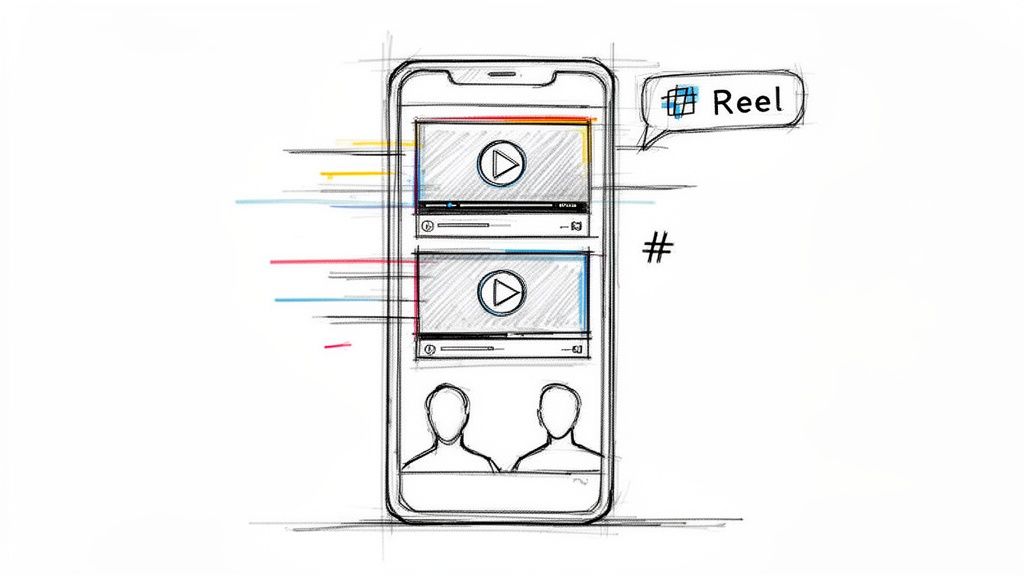
Short-form video distribution is one of the most powerful content distribution strategies available today for reaching new audiences at scale. This approach involves converting key moments from a long-form asset, like a webinar, into engaging 15-90 second video clips tailored for platforms such as TikTok, Instagram Reels, and YouTube Shorts. Instead of expecting B2B audiences to find your hour-long recording, you bring the most valuable insights directly to them in a highly consumable format.
This strategy capitalises on the explosive growth of vertical video, transforming a single webinar into a stream of attention-grabbing content. The core principle is to isolate one powerful idea, tip, or quote per clip and package it for rapid consumption. This method was pioneered in the B2B space by figures like Gary Vaynerchuk, who proved that even complex business topics could gain massive traction when presented in a short, dynamic format.
Why this strategy is essential for B2B teams
Webinar content is often packed with expert advice that gets lost after the live event. Short-form video unlocks that value, placing your brand and expertise in front of millions of potential customers on platforms where they are already spending their time. It's a low-cost way to build brand awareness and drive top-of-funnel engagement.
- Maximises Reach: Leverage powerful platform algorithms designed for virality to get your message in front of audiences who don't follow you yet.
- Builds Authority: Consistently sharing high-value clips positions your speakers and brand as go-to experts in your industry.
- Drives Engagement: The fast-paced, high-impact nature of these videos generates more likes, comments, and shares than traditional B2B content.
Companies like Brex and Notion have mastered this, turning founder talks and product tutorials into viral clips that educate and attract new users. This isn't just for consumer brands; it's a critical touchpoint for modern B2B marketing.
Key Insight: The goal is not to shrink your webinar. It's to extract single, potent insights and present them with a strong hook and clear captions to stop the scroll and deliver immediate value.
Manually clipping, formatting, and captioning dozens of videos from a single webinar is incredibly time-consuming and requires specialised skills. To learn how to automate this entire workflow and turn one webinar into weeks of short-form video content, explore platforms that specialise in video repurposing. Find out more about streamlining your webinar-to-video workflow on repurposemywebinar.com.
5. Email Marketing & Segmentation
Email marketing is one of the most direct and personal content distribution strategies available, allowing you to deliver repurposed webinar assets straight to an audience that has already opted in. This strategy involves leveraging targeted email campaigns to share webinar content with existing subscribers, segmenting them by behaviour, role, or interest level. Instead of sending a generic "replay available" email, you nurture leads through the sales funnel with highly relevant, value-packed messages.
The core principle is to treat your email list not as a monolith, but as a collection of distinct groups with unique needs. A 60-minute webinar contains multiple insights, and segmentation allows you to send the right clips, summaries, and resources to the right people. This method was perfected by email marketing pioneers like Ramit Sethi and popularised in the B2B space by companies like HubSpot, who use sophisticated automation to drive engagement and conversions.
Why this strategy is essential for B2B teams
Your email list is your most valuable owned channel, full of warm leads and existing customers. Distributing webinar content via segmented emails maintains high engagement, deepens relationships, and effectively guides prospects toward a purchase decision. It transforms a one-time event into an ongoing conversation.
- Drives Nurturing: Create powerful 3-email nurture sequences from a single webinar to engage attendees, re-engage no-shows, and warm up non-registrants.
- Increases Conversion: Personalised content is more effective. B2B companies like Drift segment by company size and buying stage, sending relevant webinar clips that speak directly to a prospect’s challenges.
- Maximises Engagement: Move beyond simple replay links. Send interactive emails with polls, quizzes, or dynamic content blocks that show different clips based on a recipient’s role, boosting open and click-through rates.
Key Insight: The goal is not just to announce the webinar replay. It's to strategically deliver specific, high-value insights from the webinar directly to the inboxes of the people who will find them most relevant.
Manually creating these segmented campaigns, pulling clips, and writing unique copy for each audience is a significant time commitment. To learn how to automate the creation of email-ready assets from your webinars, explore platforms designed for content repurposing. Find out more about streamlining your email content workflow at repurposemywebinar.com.
6. Podcast & Audio Distribution
Podcast and audio distribution is a powerful content distribution strategy that taps into the growing trend of on-demand audio consumption. This approach involves converting the audio from your webinar into polished podcast episodes, audiograms, and short clips. Instead of limiting your content to visual platforms, you can reach audiences during their commutes, workouts, or while multitasking, transforming screen-free moments into valuable brand touchpoints.
The core principle is to make your expertise accessible in an audio-first format. A one-hour webinar discussion can be edited into a concise 30-minute podcast episode, complete with an introduction and professional transitions. This audio asset is then distributed across major platforms like Spotify, Apple Podcasts, and YouTube Music. This method was pioneered by figures like Joe Rogan and has been perfected in the educational space by creators like Andrew Huberman, who turn deep-dive content into highly successful podcasts.
Why this strategy is essential for B2B teams
Your audience is busy, and audio content meets them where they are, without demanding their full visual attention. Repurposing webinar audio into a podcast extends the life of your original investment and builds an intimate, long-term connection with listeners, establishing your brand as a go-to resource in your industry.
- Expands Reach: Access a new audience segment that prefers audio content, capturing attention during non-work hours.
- Builds Authority: A consistent podcast series positions your brand as a thought leader, creating a loyal subscriber base.
- Increases Engagement: Use audiograms (short audio clips with a waveform video) on social media to drive traffic to full episodes and spark conversations.
B2B brands like Drift effectively use this strategy by publishing webinar recordings as podcast episodes, reaching thousands of listeners on platforms like Spotify and using engaging audiograms to promote them on social channels.
Key Insight: The goal isn't just to upload raw audio. It's to professionally edit, package, and distribute it as a dedicated audio experience that respects the listener's time and delivers clear value.
Manually editing audio, creating show notes, and distributing to multiple podcast hosts is a complex and time-intensive process. To learn how to automate the conversion of your webinar audio into a professional podcast series, explore platforms that handle the entire workflow. Find out more about streamlining your audio repurposing on repurposemywebinar.com.
7. Paid Advertising & Promotion (Sponsored Distribution)
Paid advertising is one of the most direct and scalable content distribution strategies for amplifying your repurposed webinar content. This approach involves using paid channels like LinkedIn, Google, and YouTube ads to push your valuable assets in front of highly targeted audiences. Instead of waiting for organic discovery, you strategically invest to accelerate lead generation and ensure your best content reaches potential customers immediately.
The core principle is to bypass the limitations of organic reach by paying for premium placement. A short-form video clip from your webinar can become a top-performing LinkedIn ad, while a blog post derived from the Q&A session can be promoted via Google Ads to capture high-intent search traffic. This methodology, popularised by figures like Russell Brunson through funnel-based advertising, transforms content from a passive asset into a proactive lead-generation tool.
Why this strategy is essential for B2B teams
Even the best content can fail if no one sees it. Sponsored distribution guarantees visibility, allowing you to control who sees your message and when they see it. This is crucial for B2B teams needing to generate a predictable pipeline of qualified leads from their content marketing efforts.
- Accelerates Lead Generation: Drive immediate traffic to landing pages and capture leads, unlike slower organic methods. For example, Drift reportedly achieved a 3.2x ROAS promoting webinar clips on LinkedIn.
- Guarantees Reach: Target specific job titles, industries, and company sizes to ensure your budget is spent on reaching your ideal customer profile.
- Provides Actionable Data: Paid platforms offer robust analytics, allowing you to track UTM parameters and attribute leads directly to specific ads and content pieces, proving ROI.
Companies like HubSpot leverage this by running YouTube ads for webinar replays, reportedly achieving an impressive cost per lead. This turns a single content investment into a reliable performance marketing engine.
Key Insight: Start with a small budget on a single, high-intent platform like LinkedIn Sponsored Content. The goal is to prove the model and generate data before scaling your investment across multiple channels.
8. Community & Forum Engagement (Reddit, LinkedIn Groups, Slack Communities)
Community and forum engagement is a powerful content distribution strategy that involves sharing valuable insights in niche online spaces where your target audience already congregates. Instead of interrupting prospects with ads, you join their conversations on platforms like Reddit, specialised Slack communities, or industry-specific LinkedIn Groups. The goal is to become a trusted resource by providing genuine value first, establishing credibility that makes your content a welcome contribution rather than an unwelcome promotion.
This approach centres on authenticity and relevance. Rather than dropping a link and leaving, you answer questions, participate in discussions, and share repurposed snippets from your webinar-like unique data points or contrarian opinions-only when they directly address a community need. Figures like Paul Graham of Y Combinator popularised this by sharing deep insights in forums, building immense authority and attracting the right audience organically.
Why this strategy is essential for B2B teams
Your ideal customers are already asking questions and seeking solutions in these communities. By being present and helpful, you build brand trust and can gently guide interested members back to your high-value assets. This method generates highly qualified traffic because the audience has already self-identified as being interested in your area of expertise.
- Builds Authority: Consistently providing expert answers positions your brand as a go-to resource in your industry.
- Drives Niche Traffic: Attract highly relevant visitors who are actively seeking solutions, leading to better conversion rates.
- Generates Warm Leads: Members who discover your content through a helpful comment are far more receptive to your brand than those who see a cold ad.
For B2B brands, this is about playing the long game. Marketing agencies often generate high-quality leads from LinkedIn Groups by sharing case studies, while tech founders build credibility by answering questions on Reddit's r/startups. The key is consistent, non-promotional participation in a few key communities.
Key Insight: The aim is not to broadcast your webinar but to become part of the community. Share your content as a solution to a problem, not as a piece of marketing material.
Manually monitoring and engaging in multiple communities can be time-consuming. To efficiently pull shareable insights and data points from your webinars for these platforms, you need a streamlined workflow. Learn how to automate the extraction of these valuable nuggets by exploring platforms that specialise in webinar content creation. Find out more about streamlining your webinar repurposing on repurposemywebinar.com.
9. Influencer & Partnership Distribution
Influencer and partnership distribution is a powerful content distribution strategy that leverages the credibility and reach of established voices in your industry. This approach involves collaborating with relevant influencers, non-competing brands, and thought leaders to co-promote your webinar content. Instead of relying solely on your own audience, you tap into highly engaged, pre-built communities that trust your partners' recommendations.
The core principle is amplification through association. A single mention or share from a respected industry figure can drive more high-quality traffic than days of paid advertising. By partnering with others, you not only expand your reach exponentially but also gain a valuable third-party endorsement for your content. This strategy was effectively scaled by companies like Shopify, which built an entire ecosystem around partner-driven growth and co-marketing.
Why this strategy is essential for B2B teams
Building trust in the B2B space is a long game. Partnering with established brands and influencers provides a shortcut, borrowing their credibility to validate your own expertise. For high-value assets like webinars, this external validation can significantly boost registration numbers and lead quality, making it one of the most efficient content distribution strategies available.
- Expands Reach: A single partner like HubSpot can extend content reach by over 100,000 users, tapping into new, relevant audiences.
- Enhances Credibility: Association with a trusted brand or influencer builds immediate authority and encourages sign-ups from sceptical prospects.
- Drives High-Intent Leads: Partners' audiences are often highly qualified. Neil Patel, for example, drives up to 50% additional leads through co-marketed webinars with industry partners.
To implement this, start by identifying 10 to 15 complementary brands with overlapping audiences. Reach out with a specific collaboration proposal, offering value first, such as exclusive content access or a co-hosting opportunity.
Key Insight: True partnership marketing isn't just about asking for a share. It's about creating mutual value where both parties benefit from shared content and audience engagement.
Provide your partners with a suite of ready-to-use promotional assets like video clips, quote graphics, and pre-written copy to make sharing effortless. Manually managing these relationships and asset kits can be time-consuming. Explore platforms that can centralise asset creation and distribution to streamline your partner workflows. To see how this can be organised, find out more about automating asset creation at repurposemywebinar.com.
10. Lead Magnet & Gated Content Strategy
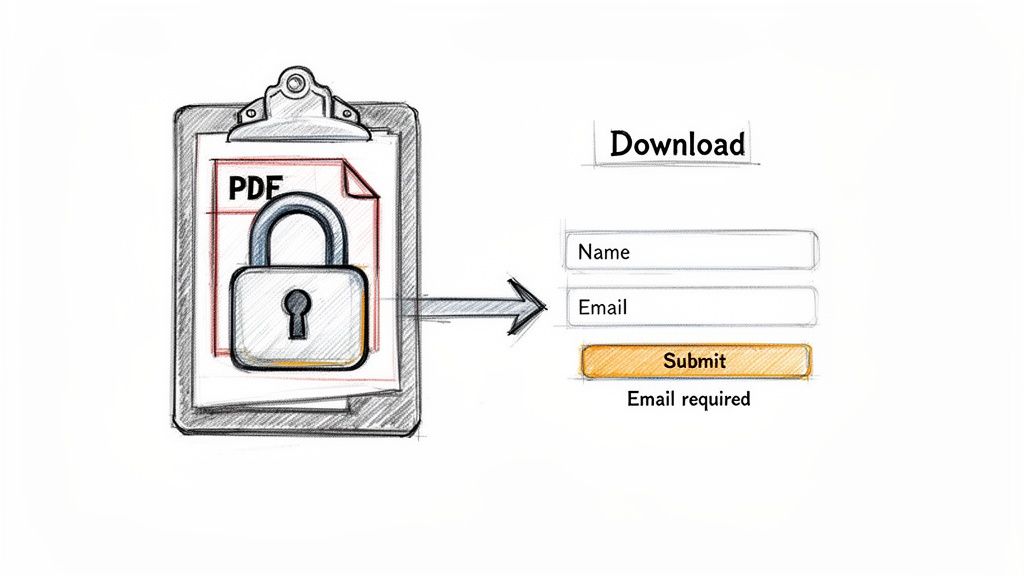
A lead magnet and gated content approach is one of the most direct content distribution strategies for converting audience engagement into tangible leads. This strategy involves transforming high-value webinar insights into downloadable assets, such as PDF guides, checklists, or templates, and placing them behind a simple email sign-up form. Instead of just sharing knowledge, you offer a valuable, packaged resource in exchange for contact information, directly fuelling your lead generation engine.
The principle is a value-for-value exchange: you provide a practical, solve-a-problem tool derived from your expert content, and your audience provides their email. A comprehensive 60-minute webinar can be repurposed into multiple gated assets, like a detailed "how-to" guide, a ready-to-use template, or an exclusive resource library. This method was perfected by industry leaders like HubSpot and Neil Patel, who turned content gating into a systematic process for building massive email lists.
Why this strategy is essential for B2B teams
Your webinar audience is already highly engaged; failing to capture their contact details for further nurturing is a missed opportunity. Gating derivative assets creates a low-friction pathway for attendees and non-attendees alike to enter your marketing funnel, turning passive viewers into qualified leads ready for your email sequences.
- Builds Your Email List: Directly converts content consumption into a high-quality list of prospects who have shown interest in your expertise.
- Improves Lead Quality: The act of exchanging an email for a resource filters for a more committed audience, increasing the likelihood of conversion.
- Provides Measurable ROI: You can track downloads, lead-to-customer conversion rates, and the overall value generated from a single webinar asset.
For example, Moz’s gated "SEO Rank Tracking" guide, created from webinar content, successfully converts attendees into leads at a 28% rate. This demonstrates the power of offering a tangible, useful takeaway.
Key Insight: The most effective gated content solves a specific, immediate problem. A title like "The 7-Step B2B Content Planning Template" will always outperform a generic "Content Guide".
Manually creating, formatting, and promoting these assets for every webinar is a significant time commitment. Automating the creation of these lead magnets is key to scaling this strategy efficiently. To learn how to instantly turn your webinar recordings into professional, branded PDF guides and other downloadable assets, explore platforms that automate the entire workflow. Discover more about automating lead magnet creation on repurposemywebinar.com.
10-Point Content Distribution Strategy Comparison
| Strategy | Implementation Complexity | Resource Requirements | Expected Outcomes | Ideal Use Cases | Key Advantages |
|---|---|---|---|---|---|
| Multi-Channel Repurposing | Medium — setup for templates and workflows | Low–Medium — content ops, editors, scheduling tools | Increased content output and cross-channel reach; improved ROI (significant uplift) | B2B SaaS and agencies maximizing webinar ROI with limited headcount | Efficient scaling of content, consistent messaging, format testing |
| Owned Media Optimization (Website & Blog) | Medium–High — SEO and editorial discipline | Medium — writers, SEO, technical maintenance | Compounding organic traffic, higher domain authority, steady lead flow | Companies with long sales cycles needing high-intent search traffic | Long-term traffic growth, full control over assets, lower CPL over time |
| LinkedIn Native Distribution | Medium — platform-specific formats and cadence | Low–Medium — native posts, video clips, team participation | Strong professional engagement and native reach on LinkedIn | B2B targeting executives and decision-makers | Native algorithmic advantage, direct access to professional audiences |
| Short-Form Video Distribution | Medium — rapid editing and strong hooks required | Medium — video editing, captions, frequent posting | High engagement and viral potential; broad awareness gains | Reaching younger B2B personas and awareness-focused campaigns | High engagement per asset, many clips per webinar, cost-effective clips |
| Email Marketing & Segmentation | Medium — segmentation, automation workflows | Low–Medium — ESP, copywriting, list management | High ROI and measurable conversions from warm audiences | Established lists aiming to nurture and convert leads | Direct relationship, highly measurable, best ROI channel |
| Podcast & Audio Distribution | Low–Medium — audio editing and episode structuring | Low–Medium — audio editor, hosting, transcripts | Long-form engagement and loyal listeners; on-the-go consumption | Educational or interview-style webinars for niche professionals | Long consumption sessions, repeat listeners, lower video production need |
| Paid Advertising & Promotion | Medium–High — campaign setup and continuous optimization | High — ad spend, targeting tools, ad ops expertise | Rapid reach and lead generation with clear attribution if optimized | Accelerating lead gen or testing new audiences before scaling organic | Scalable reach, precise targeting, quick results |
| Community & Forum Engagement | Medium — sustained, authentic participation needed | Low — time and community management (labor-intensive) | Niche credibility, organic sharing, slower but high-quality referrals | Founder-driven growth, long-term credibility in niche communities | Authentic engagement, low monetary cost, high-intent audience exposure |
| Influencer & Partnership Distribution | Medium–High — relationship building and coordination | Medium — partner management, co-created assets | Exponential reach and credibility uplift through partner audiences | Scaling reach via co-marketing with complementary brands | Fast audience expansion, credibility by association, PR value |
| Lead Magnet & Gated Content Strategy | Medium — asset creation and gating infrastructure | Medium — content production, landing pages, automation | High-converting lead capture and list growth for nurture flows | Growing email lists and capturing qualified webinar-interested leads | High conversion rates, tangible value exchange, enables lead scoring |
From Strategy to Execution: Automate Your Webinar Repurposing in Minutes
We've explored ten powerful content distribution strategies, each offering a pathway to extend the life and impact of your valuable webinar content. The core takeaway is clear: creating great content is only the first step. Without a deliberate, multi-channel distribution plan, even the most insightful webinar will fail to deliver its full potential ROI.
The challenge, as many B2B marketing teams know, isn't a lack of ideas but a shortage of time and resources. Manually executing these strategies is a monumental task. Imagine the workflow: one 60-minute webinar needs to be transcribed, summarised into a blog post, clipped into a dozen short-form videos, designed into 16 image quotes, and then scheduled across LinkedIn and email. This process often involves coordinating with video editors, graphic designers, and copywriters, taking weeks of effort and costing thousands of US dollars. The friction is so high that most webinars are simply left to gather dust, their lead-generation potential wasted.
Bridging the Gap Between Knowledge and Action
This article has armed you with the 'what' and the 'why' of effective content distribution. You now understand the value of:
- Diversifying Your Channels: Relying on a single channel is risky. A robust strategy integrates owned media like your blog, shared channels like LinkedIn, and paid channels for targeted reach.
- Repurposing for Context: A video clip for TikTok needs a different format and tone than a deep-dive blog post for SEO or a text-based summary for a Slack community. Content must be adapted to fit the platform.
- Measuring to Optimise: Tracking metrics like engagement rates, click-through rates, and lead conversions is non-negotiable. This data is essential for refining your content distribution strategies and proving their value.
However, the critical bottleneck remains the 'how'. How can you implement this sophisticated, multi-asset strategy without burning out your team or blowing your budget? The traditional, manual approach is fundamentally broken and not scalable. The true competitive advantage lies not just in knowing these strategies, but in being able to execute them efficiently and consistently. This is where automation becomes a strategic imperative, transforming your content workflow from a cost centre into a predictable revenue driver.
Key Insight: The success of your content programme is not determined by the quality of your webinars alone, but by the efficiency and scale of your distribution engine. Automating the asset creation process is the single most effective way to unlock the latent value in your existing content library.
Instead of seeing distribution as a series of disparate, time-consuming tasks, it's time to view it as an integrated system. By automating the most repetitive parts of webinar repurposing, you free your team to focus on higher-value activities: analysing performance data, engaging with your community, and building strategic partnerships. This shift from manual execution to strategic oversight is what separates high-performing marketing teams from the rest. You can finally move from knowing what to do, to actually getting it done at scale.
Ready to stop the manual grind and turn your webinar library into a powerful lead-generation machine? RepurposeMyWebinar uses AI to automatically transform a single webinar recording into a full month of ready-to-publish assets—including video clips, image quotes, and blog posts—in under 10 minutes. This eliminates the need for multiple tools, freelancers, or manual work. Get professional results, save countless hours, and finally prove the ROI of your webinar programme.
See how it works and start your free trial today at RepurposeMyWebinar.
